Stories From The Past...

Every article gives you a written summary, a link to the YouTube documentary, and a full list of sources from the archives.

‘The First Policeman Killed on Point Duty’ – A Fatal Crash at Ludgate Circus, 1913

‘The First Policeman Killed on Point Duty’ – A Fatal Crash at Ludgate Circus, 1913

John Smith (likely born around 1872–73 in Essex) starts in the records as the son of Sidney Smith, a coffee-stall keeper — the kind of work that meant early hours, street pitches, and respectability earned the hard way. By the 1890s he disappears from a neat paper trail (partly because “John Smith” is not so much a name as an administrative fog), and later sources hint at a spell in the Marines, though the surviving proof is indirect rather than a tidy service record.In 1899 he married Clara Simmons in Kent, and by 1901 he’d made a clear step up: a City of London Police constable living with Clara and their children, Ethel and John Sidney. By 1911 the family were based at St Paul’s Churchyard — close to Bridewell and the busiest, most unforgiving streets in the City.On 20 January 1913, while on point duty at Ludgate Circus regulating traffic by hand and whistle, John was struck by a motor omnibus and died within minutes. The inquest returned the familiar verdict of “accidental death”, but the evidence and the jury’s recommendations read like an early argument for modern road safety. He was buried with full honours after a large public funeral, while at home the aftermath was quieter: Clara never remarried, Ethel lived with her mother for many years, and John Sidney becomes difficult to trace after 1911. 
Read More
How to Get Deported from Victorian Britain in 3 Easy Crimes

How to Get Deported from Victorian Britain in 3 Easy Crimes

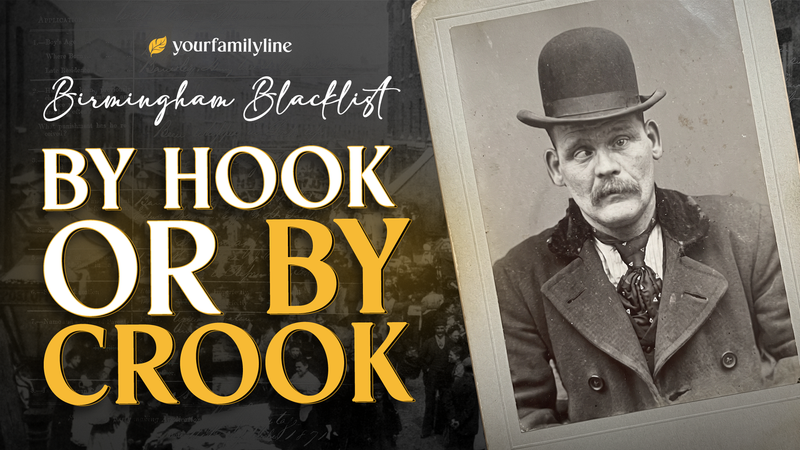
Bernhard (also Bernard, occasionally Bernhardo) Piepho was a Prussian musician who spent the mid-1880s drifting through Devon, Worcestershire, Somerset and Herefordshire, surviving on casual work, street music, and increasingly on theft. In 1886 he stole a coachman’s coat and hammer from a country house near Teignmouth, selling the coat in a local pub after telling a painter he was a deserter from the Prussian army on his way to Aldershot. Within a year he’d been arrested again in Worcester for stealing a bicycle, and then in Yeovil for walking off with a pair of brewery hand trucks, usually turning up in court in some version of military dress and claiming service in the Franco-Prussian War. His final known offence in Britain came in 1888, when he broke into a Nonconformist chapel at Stoke Prior, Herefordshire, and was sentenced at the Quarter Sessions to twelve months’ hard labour. On his discharge from Hereford Prison in 1889, officials entered him in the Habitual Criminals Register in microscopic physical detail and added one stark line under “Destination on discharge”: “Germany.” Piepho’s story is a small but revealing case of how late-Victorian Britain dealt with poor, mobile foreign workers – not as tragic heroes or master criminals, but as inconvenient administrative problems to be fined, catalogued, and quietly sent out of the country.
Read More
50+ Arrests: The Tragic Fall of This “Respectable” Victorian Woman

50+ Arrests: The Tragic Fall of This “Respectable” Victorian Woman

Bessie Tyson was born in 1870 in Toxteth Park, Liverpool, the only child of Miles and Louisa Tyson – a lower-middle-class clerk-and-accountant household that did everything “right” by Victorian standards. By the 1890s, after the family’s move to London, Bessie’s life had slipped into a destructive relationship with alcohol. Between her early twenties and mid-thirties she appeared in the North London Police Court dozens of times for drunkenness in Dalston and Islington, was described in the press as “young but incorrigible,” and was eventually labelled by officials as a “police problem.” Under the Inebriates Act she spent years in and out of prison and certified reformatories such as Farmfield in Surrey and the Eastern Counties Inebriates’ Reformatory, often recorded with no fixed abode and precarious work as a charwoman, machinist and, at one point, as a prostitute. Her parents died in 1901 and 1905, removing the last stable support in her life. Bessie died in Stepney in 1929, recorded as a spinster and charwoman, from influenza and bronchopneumonia. Her story exposes how late Victorian and Edwardian Britain chose to criminalise addiction, especially in women, turning a respectable clerk’s daughter into a lifelong “case” of the courts.
Read More
Why Was This Victorian Boy JAILED for Bread and Sugar?

Why Was This Victorian Boy JAILED for Bread and Sugar?

Sidney Attfield was born in 1840 in the rural parish of Albury, Surrey, the son of agricultural labourer John Attfield and his wife Ann, and grew up in a large, struggling family that eventually sent some of its children into the Guildford Union workhouse. As a teenager Sidney drifted between the workhouse, casual labour and the streets, and at sixteen he broke into a house and stole bread, sugar, a saucepan and a wedding ring, telling the constable he had done it “from hunger,” beginning a long pattern of petty thefts, short prison terms and repeated returns to the workhouse. In 1860 he enlisted in the British Army and served in Ireland, Malta and India, but was discharged after six years as medically unfit with only a small pension, and by the 1870s he was once again in and out of prisons and London workhouses, eventually appearing in the Habitual Criminals Register after stealing seven onions. By 1881 he was recorded as a single, homeless “vagrant” in the Guildford Union’s casual ward, and after that he disappears from the records entirely, his life illustrating how Victorian poverty and poor law institutions could absorb a man from childhood and still leave no clear trace of his end,
Read More
His Own Mother Sent Him to Prison – One Of The Saddest Story I’ve Researched

His Own Mother Sent Him to Prison – One Of The Saddest Story I’ve Researched

Alfred Yarrow was born in 1887 at 2 Walker Place in Tynemouth, Northumberland, the son of a skilled lamp maker, Marshall Yarrow, and his wife Jane, and he grew up in a crowded working class tenement with six siblings. In the early 1890s the family was hit by a succession of tragedies as his father died of tuberculosis, two brothers and his grandfather died within just a couple of years, and his widowed mother was pushed into hard, insecure work as a charwoman while Alfred went out to earn as an errand boy. By his late teens Alfred had slipped into homelessness around North Shields, sleeping in a wash house near the street where he was born and drifting out of regular work, which brought him into conflict with both the Vagrancy Act and his own mother after he stole small items and money from home to pawn for cash. In 1905 he was twice prosecuted with his mother giving evidence against him, and a sentence of hard labour in prison, combined with years of poor housing, malnutrition and family susceptibility to tuberculosis, left him weakened. In September 1906 he died of phthisis pulmonalis at the age of just eighteen. After his death, his mother Jane survived into 1915, his older brother Oswald lived on into the 1940s, and his sister Jane married, emigrated to Canada and reached the age of 104, carrying the Yarrow story far beyond the streets where Alfred’s short life unfolded.
Read More
I Uncovered What Happened to This Forgotten Victorian Actress

I Uncovered What Happened to This Forgotten Victorian Actress

Kathleen Blanche Pullan was born in 1871 in New Cross, south London, into a respectable, upward-moving engineering family. That promise collapsed when her mother was left bedridden after childbirth, then died in 1881, and her father deserted the children, leaving Kathleen to grow up in a sibling-run household held together by sheer will rather than parents. Her escape route came through her older sister Ada, who reinvented herself as the actress and artist’s model Dorothy Dene, muse to Sir Frederic Leighton. Following her into showbusiness, Kathleen took the stage name Kathleen Dene and joined her sisters as “the Misses Dene,” a late-Victorian sister act; she appeared in London comedies like Sixteen, Not Out and toured with respected companies, one of “the Sisters Dene, the well-known actresses” living in a smart West Kensington flat. After Leighton’s death in 1896 and Dorothy’s in 1899, the scaffolding around Kathleen’s life fell away. By 1901 she was no longer in a fashionable flat but a pauper patient in Marylebone Infirmary; she married a barman, Charles Marvin, appeared again in a Poor Law infirmary in 1903, and by 1904 was being dragged before Marylebone Police Court as a “drunk and incapable” actress, eventually placed on the Habitual Drunkards Register and sent to an inebriate reformatory for three years. While she was confined, Charles drank himself to death from cirrhosis. In 1908, Kathleen died in the Strand Union Infirmary, a homeless widow in her thirties, weakened by infection and poverty. Her sister’s face lived on in famous Victorian paintings; Kathleen’s survived only in hospital registers, court reports and a single blurred photograph – a forgotten actress whose life slipped from West End applause to a workhouse ward.
Read More
I Uncovered How This Boy Thief Became a WW1 Hero

I Uncovered How This Boy Thief Became a WW1 Hero

John William Hedges was born on 22 April 1874 at 108 Meadow Street in Sheffield, the son of table-blade forger John Hedges and Mary (née Pigott), a working-class family living in the heart of the city’s metal-trades district. His childhood was marked by instability: in the 1881 census his mother listed herself as “single” under her maiden name, and his father appeared only as a “boarder” with a misspelled surname. Three years later, Mary died, leaving ten-year-old John in a fractured home with a sick, struggling father.
Read More